
VL concept theory
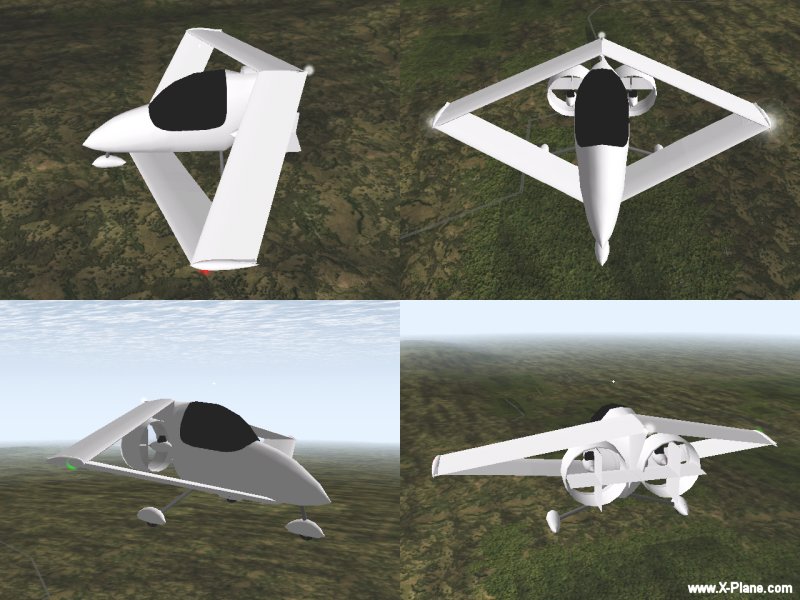
This is X-V8L flight model developed using
X-Plane
On this page, I will try to explain why this thing flies
and why is it supposed to fly better than
MC15 Cricket
which has almost the same characteristics (twin engines, wing area, weight).
Of course, the new idea is it's wing; rest of the components (propellers,
wheels, avionics, canopy, pilot and so on) can be found in anything that flies
:)
Remark: what does "X-V8L" means? "X" is from eXperimental, of course.
"VL"? "V" is the shape of front wing, and "L" is the shape of back wing. Aaaahm?
Russian "L", what is: "/\". Now, use your imagination to find what part of
design reminds "8" in shape 8-)
Introduction
First of all, I'll remind you of today's most common airplane schematics.
I'll also try to briefly (very briefly!) point pros & cons of each scheme.
So, here we go:
-
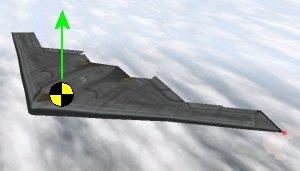
Flying Wing - Although this one seems to be the most simple, well, it's
actually not. It's aerodynamics are close to ideal, only lift and almost no drag...
But it's unstable and difficult to handle as control surfaces are relatively
close to CG. Thus flying wings are uncommon; few of them that actually do fly
(like this "B-2") are usually equipped with artificial stability resources.
Lift vector (represented as green arrow below) is right above
Center of Gravity (represented as funny yellow/black ball).
-
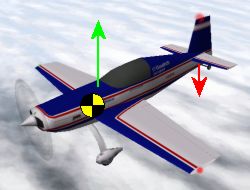
Conventional - As it's very name says it's the most common scheme. This
happens to this scheme's high stability and easy handling. But nothing is perfect,
and the price of it's stability is... Well, look at figure below. CG is
a bit in front of wing lift vector. So, wing is pulling up and airplane's nose is
pulling down. To solve that there is horizontal stabilizer pulling
airplane's tail down to compensate wing-CG moment. Simple and stable,
but not very efficient aerodynamically, as engine wastes it's power producing 2
opposite vectors that are subtracted.
-
Canard - No, this isn't just conventional scheme backwards
:)
First planes like "14-bis" and "Wright Flyer" were conventionals backwards but
then designers noticed that forward configuration is much more stable. So, why does it
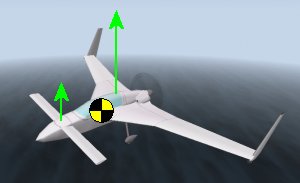
still exists? Today's canards are different. Take a look at this "Long-EZ" by Burt Rutan.
Both wing and horizontal stabilizer produces lift. CG is now located between
wings (yes, now stabilizer acts as wing!) right in the place where front wing lift moment
compensates back wing one. This makes canard much more stable but it is still more
difficult to handle than conventional airplane.
VL concept
So, what exactly VL scheme is? Nothing more than hybrid of biplane, canard and... flying wing.
What makes me think so:
-
Biplane: looks more like "joined wing" (see below) but actual VL concept
derivates directly from "ring wing" (see below).
-
Canard: instead of top and bottom wings as every biplane VL's
wings are front and back with CG between them.
-
Flying wing: as I said before, my inspiration was a so-called "ring wing"
where wing has no tips because it is, well, round. Thus VL can be seen as unique
wing instead of 4 connected surfaces (use your imagination once again).
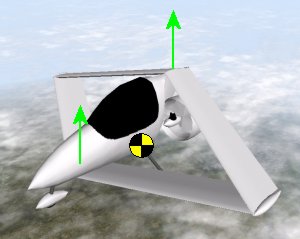
Both front and back wings of VL scheme
create almost the same lift, so CG is exactly at middle of them. I say "almost the same"
because if it were same the airplane's natural behavior would be "climb until stall", and we
want something that flies horizontally thus front wing has lower incidence and CG itself
is a bit in front of middle point.
And here come promised illustrations of ring, joined and box wings (click on pictures to follow to
original context sites):
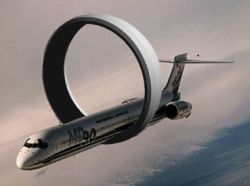
|
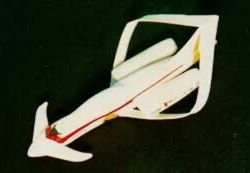
|

|
| Ring wing concept (montage) |
Joined wing concept by Jose E. Araya |
Box wing concept by Lockheed Martins |
Of course, my X-V8L looks like "joined wing" airplane. But strangely, I did not even knew about
existence of such idea until I started to write this text (at this point I'm yet another
"bicycle inventor" who could save a lot of time just seeking in
Google :)
My primary thought was to design a ring wing which could fly with no stabilizers and neither
fuselage. But "smooth" ring wing is very complex even to be drawn (airfoils "morph" between top,
sides and bottom). Also ring wing alone is not stable, it needs extra surfaces to give it stability.
You can see stabilizers on every one of 3 similar concepts from above.
VL has approach a bit different from ring wing: instead
of smooth cylindrical wing it is composed by 4 surfaces composing 3D parallelogram. This makes the
structure itself very robust and able to handle heavy G-load... Or allows one to use lighter
and thinner (and less expensive!) materials to build such airplane. Also, when you decompose
lift vectors of 4 surfaces you see that VL wing by itself has everything to keep it stable
on 3 axes; so it doesn't need stabilizers and neither anything else to fly well!
Thus I frequently refer to X-V8L fuselage as "gondola"; it's 100% utilitary structure with only
purpose to carry the payload (pilot). If specific X-V8L case it also holds wings from escaping
and two engines with counter-rotating propellers. I firstly thought to put engines at tips of
wings so changing propellers pitch would give yaw control but it seems that this concept
applies much better to jets.
Analogs

|
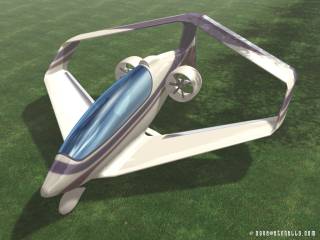
|
| Ligeti Stratos |
Virginia Tech & Loughborough University Ikelos |
Lots of thanks to Graham Addis to gather out these beautiful planes on the Internet!
As I said before, I had no knowledge about these planes when I started drawing
first VLs on paper sheets. AFAIK, they're patented designs, and Stratos
layout dates back to 1982 (Ikelos dates 2001 which is later to my very first
box wing idea but I started my real efforts to "research" at 2003 so it's older also :)
The main difference between my VL concept and these box-wings is that both Stratos
& Ikelos still have vertical stabilizers. This adds more surface joins and
consequently weakens box structure. Thus VL concept uses other approach: dihedral is
bigger and the structure is perfectly symmetrical in 3 axes. My supposition is that
aerodynamic force vectors from dihedral wings will give enough yaw stability so
dedicated structure will only increase the drag. And yaw control can be obtained
by thrust vector scheme, thus why VL is both bi-motor and duct-fan.
I hope that differences are enough to not to claim "know-how", and this way I
expect to build VL concept-based prototype one day :)
Advantages?
- Very low drag. There are no stabilizers to provide additional drag.
- Very strong box structure. No need to point that joined wing tips increase wing's resistance.
- Simple structure. Supposed to be easily made using composite materials (thought strong and low drag?)
- Great payload VS small size. X-V8L has 4m2 wing area which is enough to lift one man. But airplane's dimensions are only 2.5x3.5 meters!
- High cruise speed. Doesn't look obvious, but due to low drag and thin airfoils X-V8L's cruise ground speed is 145 knots. Not bad for twin 15 hp engines.
- Stability on high attack angle. Property of every flying wing scheme. (VL is "abstract" flying wing).
- High yaw stability. As wing surfaces come with "required" dihedral there are stability vectors on all 4 wings.
Disadvantages?
- My English!
- Small span means low inertia. X-V8L is unable to fly with single engine; it needs at least two propellers to not to "swirl".
- Being that short and with no "real" stabilizer pitch operations require some care.
- Being fast is bad for landing. No comments here...
- Being fast is bad for tiny engines. X-V8L flies great on horizontal but it still climbs as underpowered airplane.